
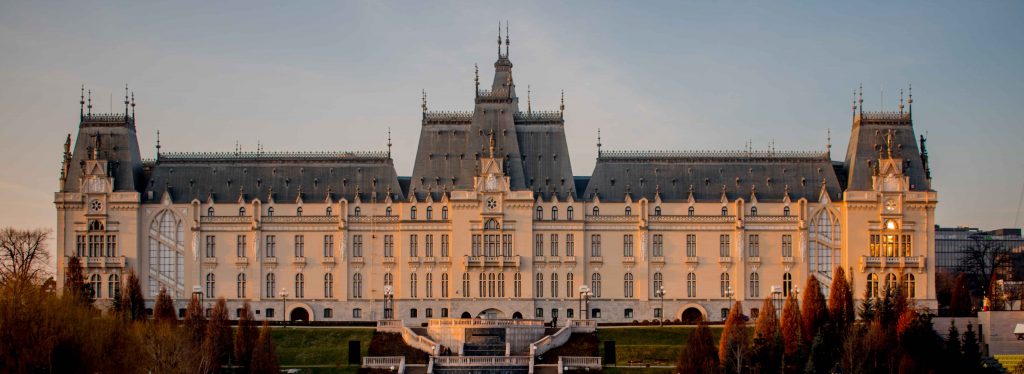
Iasi is the most important political, economic and cultural centre of the province of Moldavia as well as one of the oldest cities in Romania. Located in the northeastern part of the country, Iasi was for many centuries the crossing point of the most important commercial routes linking Poland, Hungary, Russia and Constantinople.
Deeply rooted in history, Iasi has been the main centre of Moldavian culture, since late 1300s. The city prides itself with being the place in which the first Romanian newspaper has been published. Iasi is also the home of the first Romanian university and is – during the present time – the second-largest university centre in Romania.
Over the past 600 years, history, culture and religious life have molded the city’s unique character.
Iasi boasts an impressive number of Orthodox churches, over 100, many of them located in its central area called Golden Plateau (Platoul de Aur). The oldest, Saint Nicholas Princely Church, dates from the time of the region’s greatest rulers, prince Stephen the Great (Ștefan cel Mare) who reigned from 1457 until 1504. The most spectacular churches, however, are the 17th century Saint Parascheva Metropolitan Cathedral (Catedrala Mitropolitană Sfânta Parascheva) and the Three Holy Hierarchs Church (Biserica Trei Ierarhi), both very fine examples of Byzantine art. The intricately carved outer walls of Three Hierarchs Church make many visitors think of a stone lace.
Iași is one of the very few cities in the Orthodox world which is home to more than 100 churches. In 1565, Iași became the capital of the region of Moldavia (Eastern Romania)
and – for a short period of time (1859 — 1862) – the capital of Romania.
The Golden Plateau represents the nucleus of the city, around which the entire settlement developed over the centuries. With the Palace of Culture (Palatul Culturii) at one end and the Union Square (Piata Unirii) at the other, the Golden Plateau features administrative buildings, historic churches, palaces and mansions. Many other important sites and points of interest can be found in the immediate vicinity of the Golden Plateau.
A small selection of things to see in Iasi:
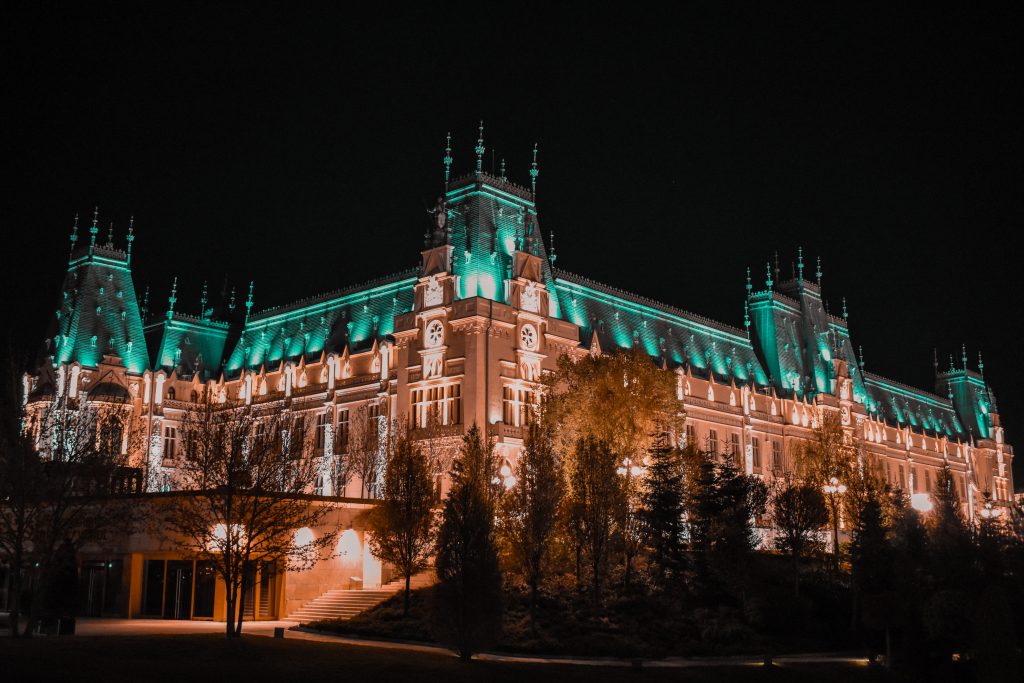
Address: Bulevardul Ștefan cel Mare și Sfânt 1
This remarkable construction (1906-1925), built in flamboyant neogothic style, stands partly on the ruins of a medieval royal court mentioned in documents dating from 1434. Today, the 365-room palace houses the Gheorghe Asachi Library and four of the city’s museums: the Region of Moldavian History Museum, the Iasi Ethnography Museum, Iasi Museum of Artand the Museum of Science and Technology.
The main lobby of Iasi Palace of Culture, its lavish furnishings and magnificent staircase, can be admired free of charge; tickets are required to visit the museums.
Web site: https://palatulculturii.ro/
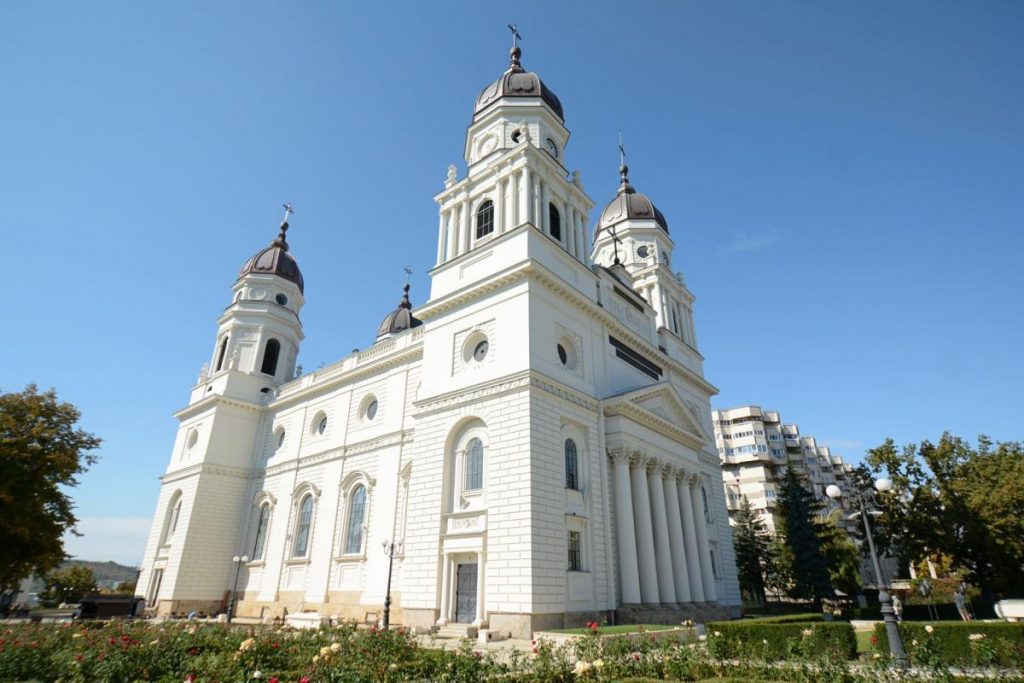
Address: Blvd. Stefan cel Mare si Sfant 46
Open: Mon. – Sun.: 9 a.m. – 8 p.m.
Free admission
Built in Italian Renaissance style, the St. Paraschiva Metropolitan Cathedral is the largest Orthodox church in Romania. Construction began in 1833 and ended in 1839, but its cupolas fell and the church remained in ruins until 1880, when, with the help of the Foundation of King Carol I, work started again, lasting until 1888. The vast interior was painted in 1887 by Gheorghe Tattarescu and the stained glass windows were completed by a Bavarian factory in Munich.
In 1639, Prince Vasile Lupu spent the entire budget of the Proncipate of Moldova for the following year and a half to acquire the relics of St. Parascheva from Constantinopole. The relics have been moved to the Mitropolitan Cathedral in 1889 after a fire damaged the Trei Ierarchi Church where they had originally been placed.
The cathedral still uses one of the original bells in its northeast spire. Inside the bell, an inscription says it was made from four cannons captured from the Turkish army in the War of 1828-1829. Nearby stands the 18th century Old Mitropolitan Church of St. George (Biserica Sfantul Gheorghe).
Every October 14, pilgrims from all corners of Romania and neighboring countries flock to Iasi to kneel before the blue and gold bier containing the relics of Saint Paraschiva, the patron saint of the cathedral.
Web site: https://mmb.ro/
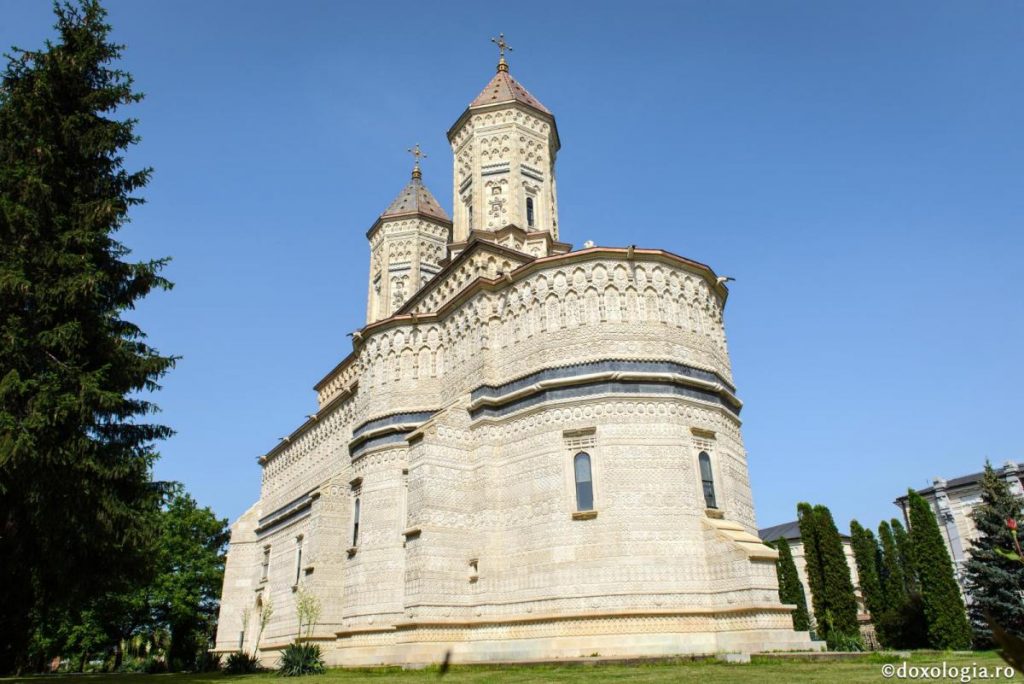
Address: Str. Stefan cel Mare 62
Open: Daily 9 a.m. — 1 p.m. & 3 p.m. — 7 p.m.
Admission charge
The Church of the Three Hierarchs (constructed 1637 – 1639) is highlighted as a must-see in every guidebook.
Nothing can prepare you, though, for its stunning ornate decoration: the entire exterior of the church is covered in delicate and intricate patterns sculpted into the stone and spread over 30 friezes. This “stone embroidery” is a mixture of western gothic, Renaissance and Oriental motifs.
Legend has it that the exterior was covered in gold, silver and lapis lazuli but centuries ago, when the Ottoman Empire tried to conquer Moldavia, the invaders sat the church on fire and melted all the gold.
The original interior paintings were completed by Russian artists sent to Iasi by the Tsar. In 1882, the frescoes were removed when French architect Lecomte de Nouy set about redesigning the interior after several fires and six earthquakes damaged the structure. Original fragments of the frescoes are still preserved in the nearby Gothic Hall museum (Open: Tue.-Sun. 10am – 4pm. Admission charge).
The interior boasts the tombs of a number of famous Romanians, including the founder of this church, Vasile Lupu, Prince Alexandru Ioan Cuza, and Prince Dimitrie Cantemir. In 1994, the church reopened as a monastery. The three patron saints (Basil the Great, Gregory of Nazianzus and John Crysostom) are celebrated here on January 30.
Web site: http://www.manastireasftreiierarhi.ro/
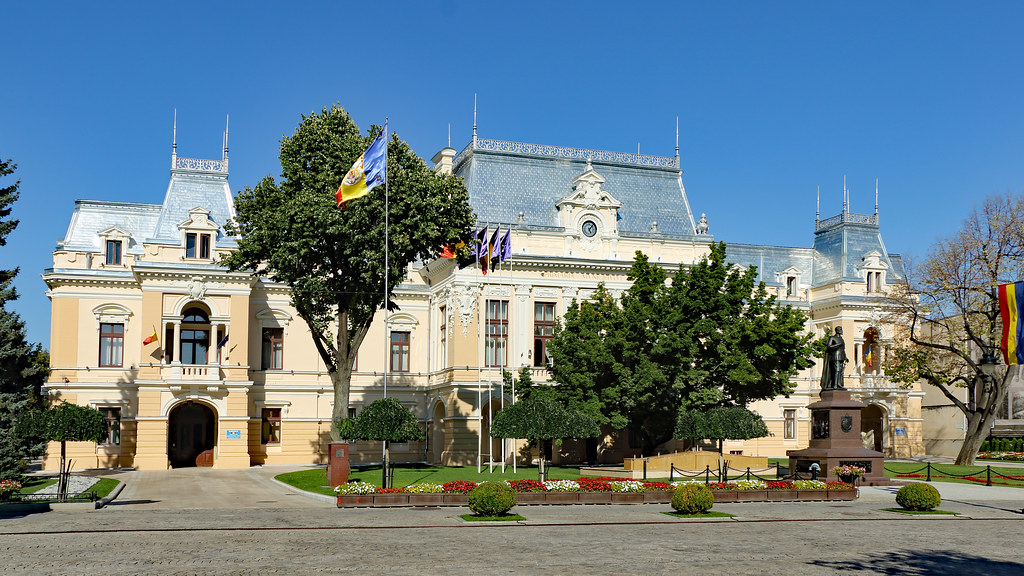
Roznoveanu Palace – Iași City Hall
Address: Blvd. Stefan cel Mare si Sfant 45
This neoclassical Viennese-style palace was built in 1832 to the design of Gustav Frey Wald. Its façade was decorated with marble statues of mythological characters such as Diana and Apollo and it was said to be grander than all other mansions in Iasi. The palace burned down in 1844 and was rebuilt by judge Nicolae Rosetti Rozvaneanu, born in a very wealthy family.
In 1891, the building became the City Hall but two years later, was transformed into a royal residence. Today, it once again serves as the City Hall.
Web site: http://www.primaria-iasi.ro/
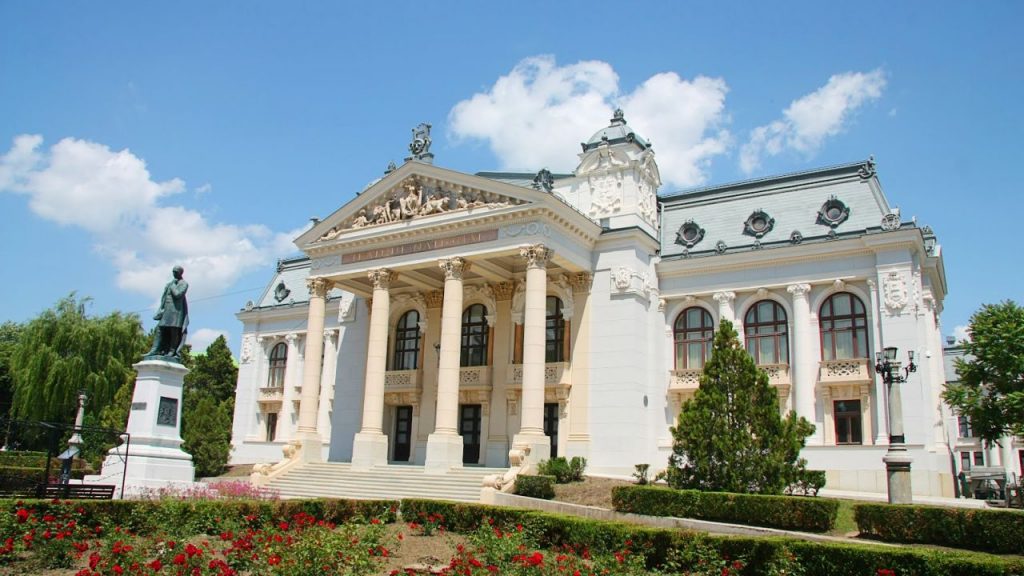
Address: Str. Agatha Bârsescu 18
Built in the late 19th century on the site of the old City Hall, this is one of the most elegant buildings in Romania. The architects were the Viennese Feller and Helmer who later built theatres in Cernauti and Sofia. Richly decorated in French-eclectic style, the theatre has one of the most splendid auditoriums in the country. It can seat 1,000 people and the acoustics are excellent.
The theatre bears the name of the company’s founder, Vasile Alecsandri (1821-1890), a renowned Romanian poet, playwright, politician and diplomat.
Web site: https://www.teatrulnationaliasi.ro//
You can find more information about Iasi on the website of the Romania Official Travel and Tourism Information Center (https://romaniatourism.com/iasi.html#)
